



WooCommerce Price Drift as a Revenue Leak: How to Audit Rule Engines, Sale Prices, Currencies, Caches, and Marketplace Overrides is not just a technical preference; it is a way to reduce uncertainty in real projects. The useful version of the topic connects code decisions with deployment risk, editor comfort, performance, and the ability to keep improving the site after the first release.
The most practical angle is checkout state, validation, payment flow, shipping logic, and recovery from partial failures. When these details are handled deliberately, the result is a lower abandonment rate, clearer error handling, and a checkout that feels fast even when APIs are slow. That is why the implementation should be treated as an engineering workflow, not as a decorative add-on or a one-time configuration task.
Where the problem usually starts
Most teams feel the pain before they can name it. A feature becomes hard to change, a plugin behaves differently on production, a deploy introduces an unexpected edge case, or a simple page takes too long to render. Those symptoms are signals that the project needs clearer boundaries, better feedback, and a more disciplined way to measure change.
For this topic, the first useful move is to make the invisible parts visible: assumptions, dependencies, failure modes, ownership, and the metrics that prove progress. Without that visibility, teams often add tools without improving the underlying workflow.
Understanding WooCommerce Price Drift as a Revenue Leak: How to Audit Rule Engines, Sale Prices, Currencies, Caches, and Marketplace Overrides
WooCommerce Price Drift as a Revenue Leak: How to Audit Rule Engines, Sale Prices, Currencies, Caches, and Marketplace Overrides is an important topic for WordPress developers, site owners, and technical teams because it affects how a site is planned, built, maintained, and improved over time.
A good implementation starts with clear goals, measurable requirements, and a practical understanding of how the WordPress ecosystem behaves in production. The right approach should balance performance, security, editorial usability, and maintainability.
Practical implementation
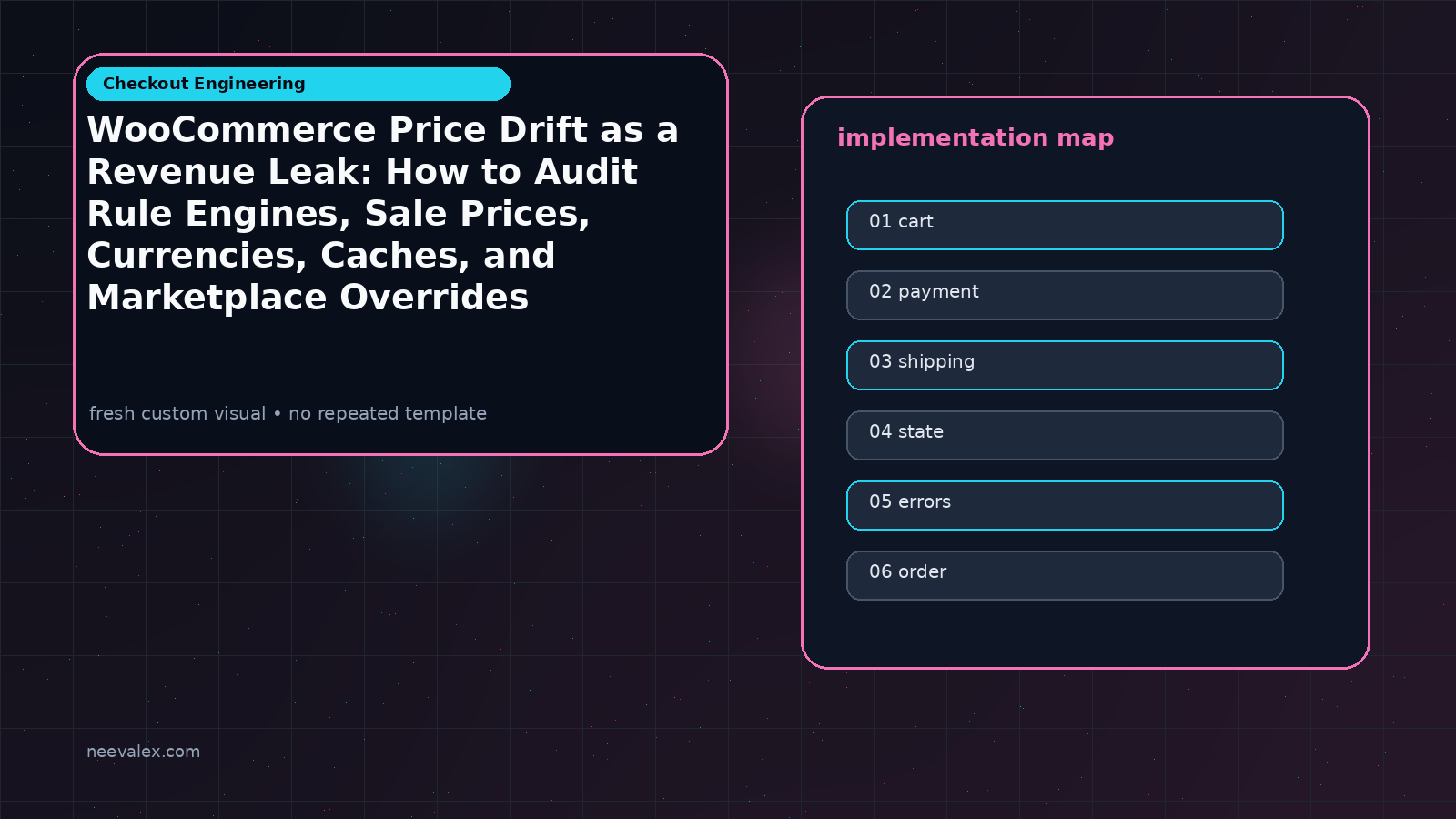
- Define the business goal before choosing the technical approach.
- Keep the implementation simple enough for long-term maintenance.
- Measure performance, security, and editorial usability regularly.
- Document the workflow so future developers can continue the project safely.
- Review plugins, hosting, and custom code as the site grows.
Long-term value
When WooCommerce Price Drift as a Revenue Leak: How to Audit Rule Engines, Sale Prices, Currencies, Caches, and Marketplace Overrides is handled carefully, teams can make better technical decisions and reduce future rework. The most successful WordPress projects usually combine clean architecture, reliable hosting, regular maintenance, and a clear content workflow.
The details may vary from project to project, but the principle remains the same: build the site in a way that supports both users and editors. That means fast pages, structured content, accessible design, strong security, and a workflow that can scale as the site grows.
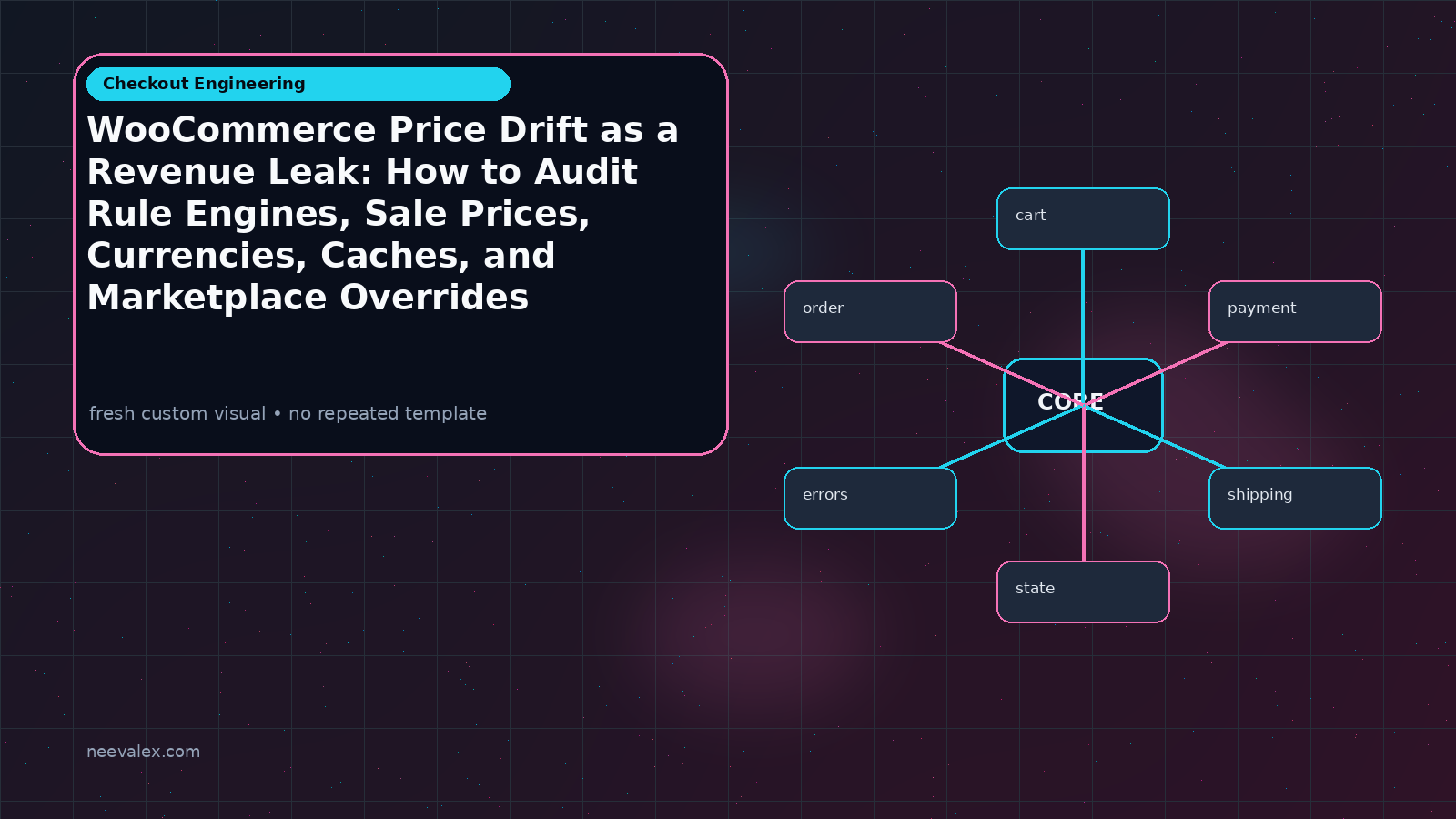
Design the workflow before choosing tools
A good workflow for WooCommerce Price Drift as a Revenue Leak: How to Audit Rule Engines, Sale Prices, Currencies, Caches, and Marketplace Overrides starts with the path a change takes from idea to production. Identify who triggers the work, which data or code is touched, which checks must pass, and what rollback looks like if the result is wrong. This turns the topic from an abstract best practice into a sequence that can be reviewed and improved.
The tool choice becomes much easier after that map exists. Instead of comparing features in isolation, the team can ask whether a tool shortens feedback loops, removes manual steps, exposes better diagnostics, or makes a risky operation safer. That is a stronger basis for a decision than popularity or habit.
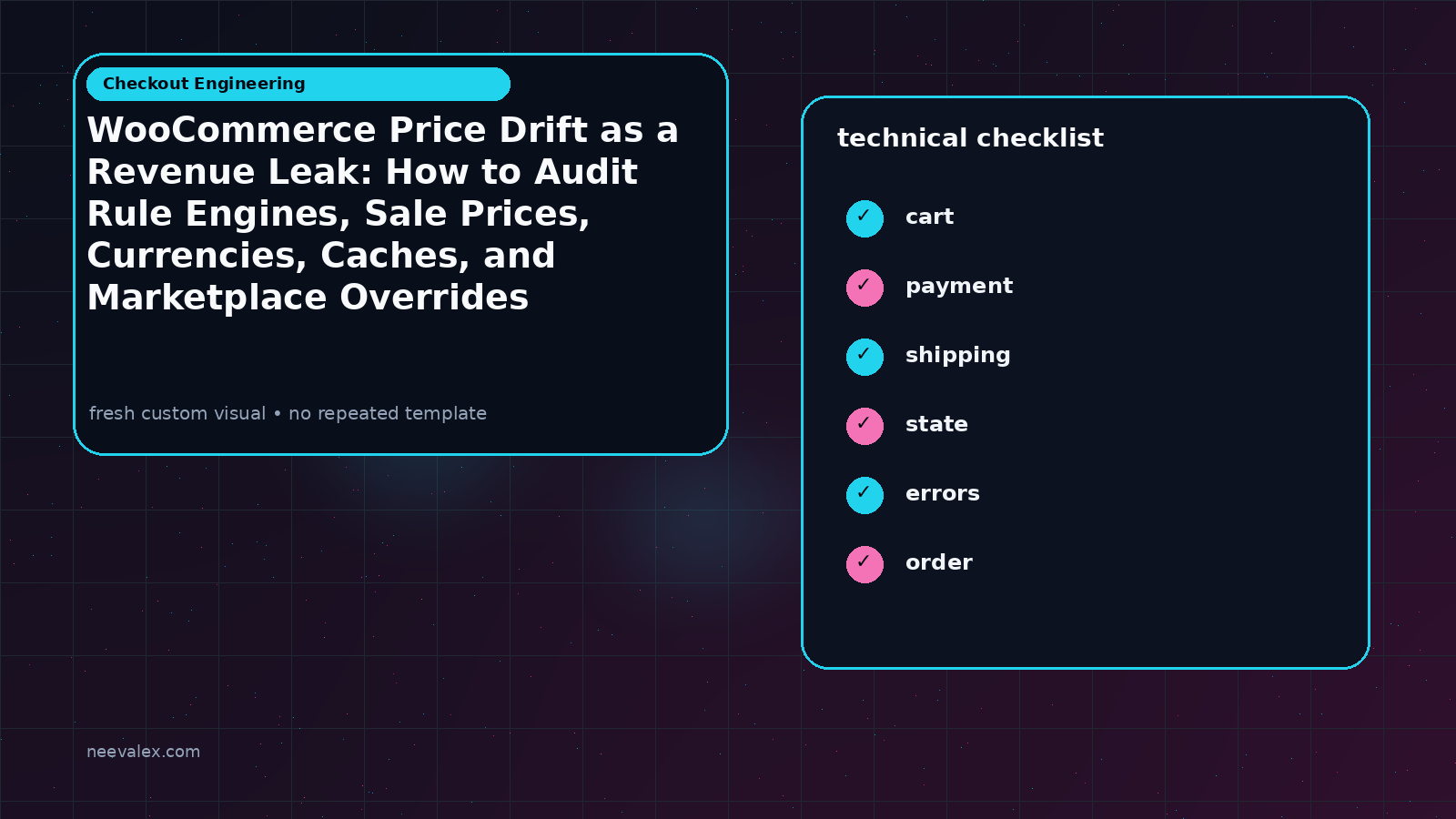
Make the implementation observable
The difference between a fragile implementation and a maintainable one is often observability. For WooCommerce Price Drift as a Revenue Leak: How to Audit Rule Engines, Sale Prices, Currencies, Caches, and Marketplace Overrides, useful signals can include build output, runtime metrics, request timing, validation errors, cache behavior, API responses, or editor-facing warnings. The exact signal depends on the project, but the principle is the same: if a decision matters, there should be a way to see whether it works.
Observability also changes communication. Instead of saying that a change should improve quality, the team can show before-and-after evidence. That evidence helps developers defend technical work, helps non-technical stakeholders understand progress, and prevents the same debate from returning every few months.
Protect the editor and the visitor
Technical improvements are most valuable when they protect the people using the site. Editors need predictable workflows, clear errors, and interfaces that do not require developer knowledge. Visitors need fast pages, stable interactions, accessible markup, and a path that does not break when one dependency is slow.
That is why WooCommerce Price Drift as a Revenue Leak: How to Audit Rule Engines, Sale Prices, Currencies, Caches, and Marketplace Overrides should be reviewed from both sides. The developer experience matters because it affects delivery speed, but the final judgment should include the editorial experience and the visitor experience. A clean implementation that confuses editors or slows users is still unfinished.
Plan for maintenance, not just launch
Launch day is usually the easiest day to understand a system: the people who built it are present, the decisions are fresh, and the edge cases are still visible. Six months later, the same project needs naming conventions, documentation, tests, dashboards, and simple operational habits that make the next change safe.
For WooCommerce Price Drift as a Revenue Leak: How to Audit Rule Engines, Sale Prices, Currencies, Caches, and Marketplace Overrides, maintenance planning means documenting the assumptions behind the chosen approach, the known limits, and the signs that the implementation should be revisited. This keeps the project from turning into a collection of clever decisions that nobody wants to touch.
Common mistakes to avoid
- Define the business goal before choosing the technical approach.
- Keep the implementation simple enough for long-term maintenance.
- Measure performance, security, and editorial usability regularly.
- Document the workflow so future developers can continue the project safely.
- Review plugins, hosting, and custom code as the site grows.
A practical next step
The best next step is specific and small: map every checkout step from cart review to order creation and identify the state that React must own. Capture the baseline, ship one controlled improvement, and write down what changed. That creates a feedback loop where every article, experiment, and production fix becomes part of a stronger engineering playbook.
If the result is useful, turn it into a repeatable checklist. If it is not useful, the measurement still helped: it showed which assumption was wrong before the team invested more time. That habit is what makes WooCommerce Price Drift as a Revenue Leak: How to Audit Rule Engines, Sale Prices, Currencies, Caches, and Marketplace Overrides valuable beyond a single post.
Before treating WooCommerce Price Drift as a Revenue Leak: How to Audit Rule Engines, Sale Prices, Currencies, Caches, and Marketplace Overrides as finished, review the implementation from the perspective of the person who will maintain it next month. That review should check naming, logging, rollback notes, and the assumptions that would be difficult to rediscover during an incident.
Another useful angle is cost of change. If WooCommerce Price Drift as a Revenue Leak: How to Audit Rule Engines, Sale Prices, Currencies, Caches, and Marketplace Overrides makes a future feature cheaper to ship, the article should explain which boundary, measurement, or workflow creates that advantage and how a developer can verify it on a real project.
A final quality pass should connect the engineering decision to an observable result. Look for one metric that improved, one manual step that disappeared, and one risk that became easier to detect before users or editors notice it.
The strongest implementations leave behind a small playbook. For WooCommerce Price Drift as a Revenue Leak: How to Audit Rule Engines, Sale Prices, Currencies, Caches, and Marketplace Overrides, that playbook can include the trigger for using the approach, the warning signs that it is being overused, and the practical fallback when project constraints change.
Good technical content should also say what not to do. In this case, avoid adding complexity just to look modern; the better choice is the smallest design that solves the production problem and remains understandable after the original developer moves on.
The review should include failure behavior, not only the happy path. For WooCommerce Price Drift as a Revenue Leak: How to Audit Rule Engines, Sale Prices, Currencies, Caches, and Marketplace Overrides, that means asking what happens when an API is slow, a cache is stale, a deploy fails, a validation rule changes, or a future maintainer misunderstands the original intent.
Documentation does not need to be heavy, but it should capture the decisions that are expensive to reverse. A short note about constraints, trade-offs, and verification steps can save hours when the same system needs to be changed under pressure.
Finally, connect the implementation to prioritization. The best version of WooCommerce Price Drift as a Revenue Leak: How to Audit Rule Engines, Sale Prices, Currencies, Caches, and Marketplace Overrides does not try to solve every possible problem; it chooses the problems that currently create the most risk, friction, or wasted time and makes those problems easier to see.
Teams should also define a stopping point. A practical implementation of WooCommerce Price Drift as a Revenue Leak: How to Audit Rule Engines, Sale Prices, Currencies, Caches, and Marketplace Overrides has enough structure to be reliable, enough evidence to be trusted, and enough restraint to avoid turning a focused improvement into a permanent maintenance burden.
When the approach is introduced into an existing WordPress project, migration strategy matters. Start with a narrow slice, keep the old behavior easy to compare, and avoid changing unrelated parts of the system until the new workflow has proved itself.
The article should leave the reader with a decision framework, not only a description. After reading about WooCommerce Price Drift as a Revenue Leak: How to Audit Rule Engines, Sale Prices, Currencies, Caches, and Marketplace Overrides, they should know when to use it, when to avoid it, what to measure first, and how to make the first implementation reversible.
For portfolio content, that framework is also part of the message: it shows that the developer can reason about trade-offs, production constraints, user impact, and maintenance instead of presenting technology as a disconnected list of features.
Additional implementation notes 1
For WooCommerce Price Drift as a Revenue Leak: How to Audit Rule Engines, Sale Prices, Currencies, Caches, and Marketplace Overrides, implementation pass 1: A deeper audit should separate symptoms from causes. In a real client project, the visible complaint is often broad, but the useful fix starts by identifying the exact system boundary where the problem appears and the upstream decision that made it possible.
For WooCommerce Price Drift as a Revenue Leak: How to Audit Rule Engines, Sale Prices, Currencies, Caches, and Marketplace Overrides, implementation pass 1: The implementation plan should include a rollback path before any risky change is made. That means knowing which files, database tables, settings, background jobs, and external services would need to be restored if the first version behaves differently from production expectations.
For WooCommerce Price Drift as a Revenue Leak: How to Audit Rule Engines, Sale Prices, Currencies, Caches, and Marketplace Overrides, implementation pass 1: Stakeholder communication is also part of the engineering work. Business owners do not need every low-level detail, but they do need to understand which risk is being reduced, what evidence will prove the fix, and what trade-off is being accepted.
For WooCommerce Price Drift as a Revenue Leak: How to Audit Rule Engines, Sale Prices, Currencies, Caches, and Marketplace Overrides, implementation pass 1: A useful article should show how to prioritize the work. Not every weakness deserves immediate refactoring; the best first target is the place where technical fragility meets revenue, customer trust, editor productivity, or recovery time.
For WooCommerce Price Drift as a Revenue Leak: How to Audit Rule Engines, Sale Prices, Currencies, Caches, and Marketplace Overrides, implementation pass 1: For maintainability, the final solution should make the next diagnosis easier than the first one. Logs, admin notices, audit trails, status screens, and clear naming are not decoration; they are how a future developer avoids repeating the same investigation from zero.
For WooCommerce Price Drift as a Revenue Leak: How to Audit Rule Engines, Sale Prices, Currencies, Caches, and Marketplace Overrides, implementation pass 1: Testing should cover the uncomfortable paths, not only the expected path. The article should discuss what happens when a request times out, a webhook arrives twice, a cache lies, a staff member edits stale data, or a plugin update changes behavior without warning.
For WooCommerce Price Drift as a Revenue Leak: How to Audit Rule Engines, Sale Prices, Currencies, Caches, and Marketplace Overrides, implementation pass 1: The technical recommendation should be reversible in stages. A controlled migration, feature flag, shadow comparison, dry run, or read-only audit mode gives the team confidence before the new workflow becomes responsible for real business operations.
For WooCommerce Price Drift as a Revenue Leak: How to Audit Rule Engines, Sale Prices, Currencies, Caches, and Marketplace Overrides, implementation pass 1: Documentation should capture decisions, not just instructions. The valuable notes explain why a boundary exists, which assumptions were tested, what was deliberately left out, and which signal would indicate that the design needs to change later.
For WooCommerce Price Drift as a Revenue Leak: How to Audit Rule Engines, Sale Prices, Currencies, Caches, and Marketplace Overrides, implementation pass 1: The strongest outcome is not only that one bug is fixed. The stronger outcome is a system where similar problems are detected earlier, explained more clearly, and handled with less panic because the workflow already expects partial failure.
For WooCommerce Price Drift as a Revenue Leak: How to Audit Rule Engines, Sale Prices, Currencies, Caches, and Marketplace Overrides, implementation pass 1: That is the difference between a quick repair and a professional engineering intervention: the repair removes the immediate pain, while the intervention leaves behind a safer operating model for the next incident, feature request, or handoff.
For WooCommerce Price Drift as a Revenue Leak: How to Audit Rule Engines, Sale Prices, Currencies, Caches, and Marketplace Overrides, implementation pass 1: The article should also translate the technical work into a buying decision. A business owner should finish the piece understanding when a senior developer is needed, what preparation reduces cost, and which shortcuts usually create a larger bill later.
 Request Access